AI vs AI Pickleball: One Model Scored 0 Points
I've been building a retro pickleball game and the AI model sailing competition sank its claws into my brain. I had to run a pickleball tournament with the top AI models playing each other. I expected a close competition, with the models ranking in a way that mirrored my daily programming experience. Instead, the scoreboard was way more lopsided than I expected, and each model developed its own distinct playstyle on the court.
Quick Disclaimer: I work at Google. I don't work on Gemini or similar products. These thoughts and opinions are my own.
Models, Harness & Tournament Setup
I'll be brief on the setup and harness but can share more details in a future post. The models were Astra 6.2, Carbon, Neon, and Opus 5.5, all at medium thinking. I fed images of an annotated court to each model at two key points: right after an opponent's shot and right after the model's own shot. I provided a bit of additional data on ball/player velocities and game physics so the models could predict future states from static images. Each model had a short notepad where they could store 3 lessons during the game that would be supplied to them in future prompts.
The Results
Every model played each other in a round robin rally-scoring format. Astra 6.2 won all 3 games, resulting in 21/21 possible points across the round robin.
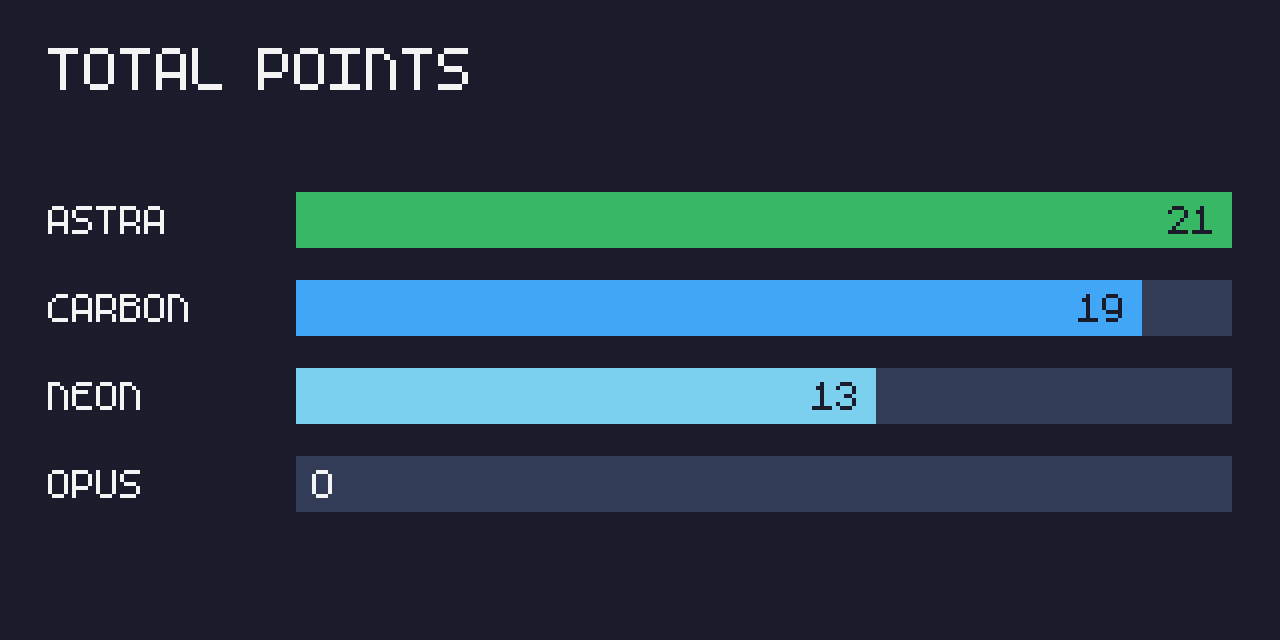
Opus 5.5 won 0/21 points. I was surprised by this. I expected that Opus' programming prowess demonstrated general abilities that would result in strong pickleball play too.
Why Did Opus Perform So Poorly?
Opus struggled in both execution and strategy in Pixel Pickleball. In execution, it failed to return balls that were returnable -- it would often move to a position in the court and wait for the ball to bounce to try to hit it. Opus would then realize too late that the ball would not bounce within its reach and miss its hit.
This point is a great example. The point starts with soft shots exchanged at the net while jockeying for position. Astra notices that Opus keeps leaving the line open. Astra tries a deeper shot down the line, Opus is out of position, stretches to cover and then Astra starts slamming. Opus returns a couple but flubs execution on the last one, waiting for the bounce to hit but positioning itself out of range for when that actually happens.
Most importantly, the models were given a chance to reflect on their rally and record notes for the next one. Opus doesn't realize that its decision to wait for the bounce and its positioning caused it to miss the shot. It doesn't tie cause and effect together.
What Made Astra So Good?
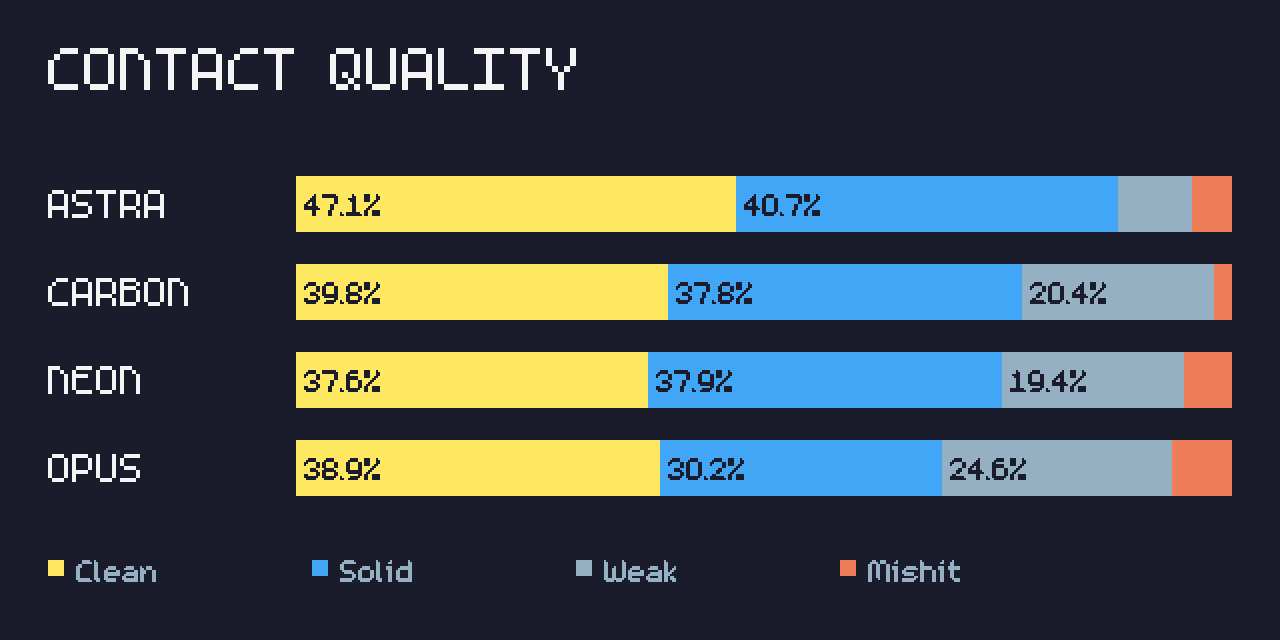
Astra found better quality contacts through its own positioning and decisions. The game rewards what would result in good contact in real life: stable feet, good spacing to the ball, and a well-timed swing. Astra was better able to calibrate these compared to the other models.
The chart below shows that Astra found Solid or better contact on 87.8% of shots, over 10 percentage points higher than the closest competitor.
Astra also played much more aggressively. The chart below demonstrates this. Astra chose to take harder (and riskier) shots rather than being content with softer strategic shots near the net.
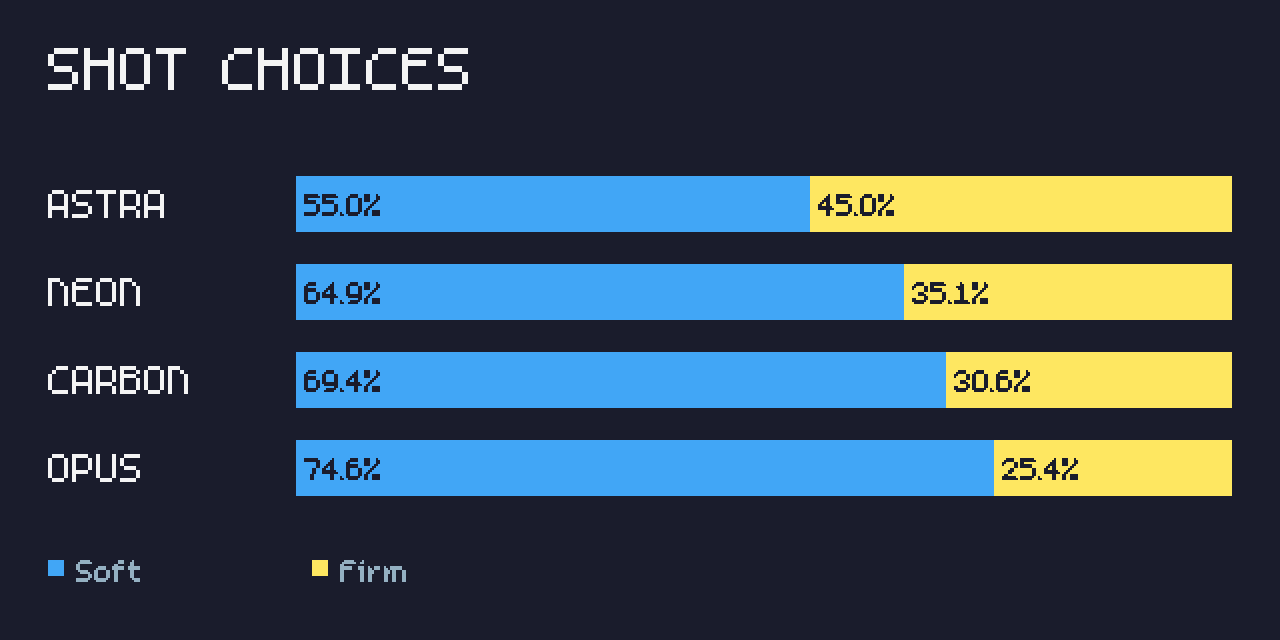
This generally worked out. Astra chose good positions to speed the ball up from, often forcing stretched saves from defenders that would cause another high ball that Astra could hit even harder. It stayed aggressive on these shots until it could find a lane to hit the ball down where defenders couldn't reach. The video below demonstrates Astra's typical playstyle:
Overall this combination of good contact quality and aggression led Astra to victory.
How About Carbon & Neon?
Both models performed much better than Opus. Carbon even neared Astra's level. But they both approached pickleball differently from Astra.
Carbon had a strategy that others didn't. Set up an opportunity, hit hard enough on an angle to force poor contact from the opponent, then let the reply sail out of bounds rather than hitting it. Watch it play out below:
On the other hand, Neon showed good technique but less of a grasp on aggressive timing. It would generally hit soft shots near the net back and forth for extended rallies. However, it didn't seem as good as Astra and Carbon at recognizing when aggression and firm shots would create larger openings from small gaps. Neon tended to hit many firm shots from poor positions. This generally meant that Neon found itself on the back foot rather than dictating the strategy of each point.
Takeaways
Astra 6.2 is the inaugural AI Pickleball Tournament champion! I would be curious to see in a larger sample if Carbon would edge out the lead given that the Astra-Carbon game ended 7-5. Maybe I will re-run on the next model release.
It's interesting to note that the overall results closely mirror the Artificial Analysis Intelligence ratings, so perhaps a Pixel Pickleball tournament is a much cheaper route to test relative intelligence?
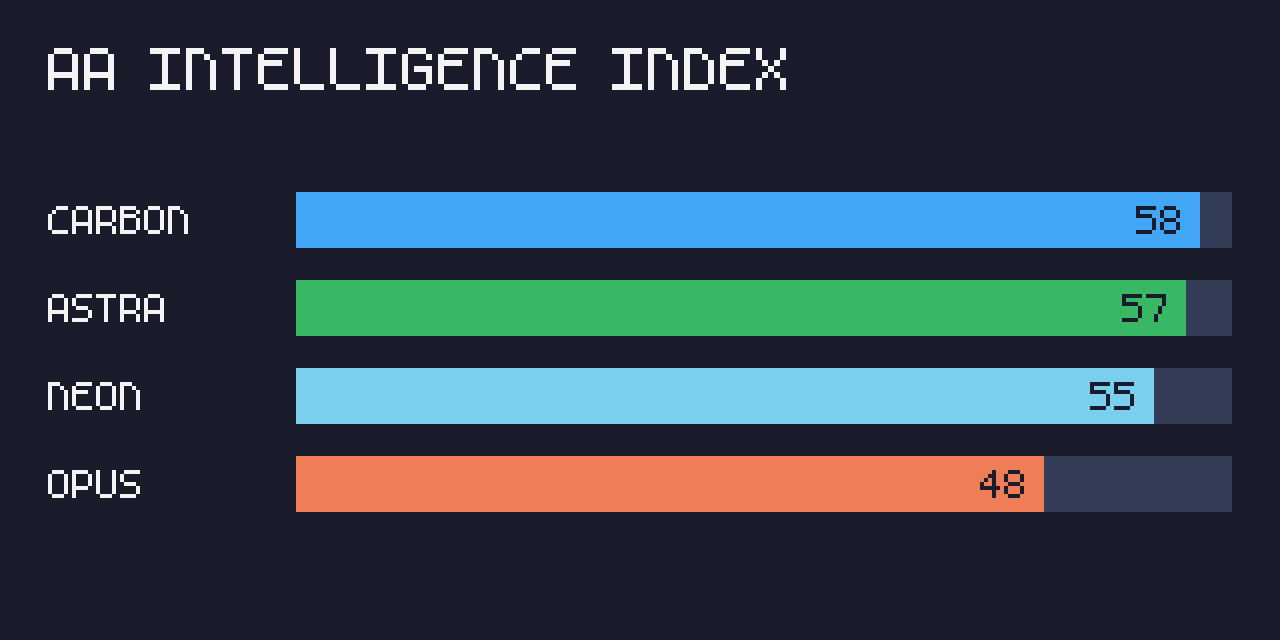
That's tongue in cheek. But I am seeing something unique in the way the models have approached a game against an intelligent opponent that single-player benchmarks don't really convey. I expect the future will have more adversarial agent-to-agent interaction than we do today (currently mainly proxied through vulnerability defense and exploitation). I'm curious to see how our benchmarking evolves to capture more of this adversarial nature.
Join the club
Get notified for the next AI tournament and game updates -- plus unlock every opponent and difficulty in Pixel Pickleball for free.
Only Pixel Pickleball updates, no spam. Unsubscribe anytime. Privacy
Welcome to the club!
Club teams, Hard and Extra hard are unlocked in this browser. Check your inbox and confirm your email to get club updates.
Play now